sábado, 26 de maio de 2012
A Ponte Golden Gate 75 anos


A Golden Gate Bridge (em português: Ponte do Portão de Ouro) é a ponte localizada no estado da Califórnia, nos Estados Unidos, que liga a cidade de São Francisco a Sausalito, na região metropolitana de São Francisco, sobre o estreito de Golden Gate. A ponte é o principal cartão postal da cidade, uma das mais conhecidas construções dos Estados Unidos, e é considerada uma das Sete maravilhas do Mundo Moderno pela Sociedade Americana de Engenheiros Civis.
Golden Gate Bridge 75
The Golden Gate: A city’s muse
So Sunday marks the 75th anniversary of our beloved Golden Gate Bridge. San Francisco is a city that has become obsessed with this grand structure, which towers above us so solidly it’s hard to even picture the time before its reign. Attempting to replicate its magical powers, artists marvel at its color and shape. Poets have blessed it with countless lines of prose. Musicians have even even reaped its steel groans for symphonic arrangements.
If you’ve never thought of yourself as a bridgeophile, this is the week to become one. Everyone is welcome to join the appreciation — and if you’re not sure where to begin, just follow the footsteps of some of its local admirers.
Aside from a myriad of parties honoring the bridge this weekend here are four things your can do today to help you get your bridge on.
1. Watch this video. The late Chronicle columnist Herb Caen used his gift for language to make event the most cynical appreciate the bridge’s wonder.
When fog pours around the bridge is there anything more beautiful?If you’ve never thought of yourself as a bridgeophile, this is the week to become one. Everyone is welcome to join the appreciation — and if you’re not sure where to begin, just follow the footsteps of some of its local admirers.
Aside from a myriad of parties honoring the bridge this weekend here are four things your can do today to help you get your bridge on.
1. Watch this video. The late Chronicle columnist Herb Caen used his gift for language to make event the most cynical appreciate the bridge’s wonder.
"At last the mighty task is done;
Resplendent in the western sun
The Bridge looms mountain high;
Its titan piers grip ocean floor,
Its great steel arms link shore with shore,
Its towers pierce the sky."
Joseph Strauss
Golden Gate Bridge - monument, work of art, star


Electrician Jamie Briggs tends to maintenance duties on the north end of the Golden Gate Bridge on May 8, 2012 in Marin, Calf.


Video
 View Larger Size
Golden Gate Bridge 75
- Golden Gate Bridge - monument, work of art, star
- Events Calendar: Golden Gate Bridge 75th Anniversary
- Bridge as brand- An icon of everyday life
- SCRAPBOOK - A Golden Gate family album
- In other words: Great quotes on the Gate
- Golden Gate Bridge keepsakes
- Span of time: Key dates in Golden Gate Bridge history
- 5 places where bridges make a difference
- Golden Gate Bridge page
What is it about the Golden Gate Bridge, anyway? It's not the longest suspension bridge in the world anymore, or the tallest. It never was the busiest.
But it's a star, the way Bacall and Monroe were stars. The way Scarlett Johansson is a star today, and that lovely woman you met at a party isn't; the way Angela Lansbury is a star and your Aunt Lizzie is just a really nice 75-year-old lady.
The Golden Gate Bridge has everything: good looks, a gorgeous setting, a distinct color, a famous city on one side and steep, rolling hills on the other. It has style and sweeping curves. It appears and disappears in the fog, it has myths and legends and, sometimes, a fatal attraction.
"A necklace of surprising beauty," Chronicle reporter Willis O'Brien called it on the day it opened 75 years ago this month. "A masterpiece," John van der Zee called it in "The Gate," a book that appeared on the bridge's 50th birthday in 1987. "I believe it is America's Parthenon," he said more recently.
"It was pretty spectacular," said Martha Furman, who was 10 years old when she walked across it on opening day, May 27, 1937, and has remembered that walk ever since. She lives in Southern California now but is thinking about the bridge's 75th anniversary. "I might come up and walk across again," she said.
Robert David has worked for the Golden Gate Bridge district for 39 years. He is both a photographer and an architect, and has been everywhere on the bridge - from top to bottom.
The secret of what makes the Golden Gate special, he thinks, is all in the proportions of the bridge and the geometry that holds it up. Its design, he says, draws the eye.
One way to see the bridge's unique character is to compare it with its slightly older neighbor, the Bay Bridge. The Golden Gate's towers are much higher - 746 feet, compared with 526 feet for the Bay Bridge. Its roadway is placed at one-third of the height of the towers; on the Bay Bridge, the road cuts the towers in half.
The result, wrote Donald MacDonald, an architect who worked on both bridges, is "an aesthetically pleasing imbalance and sense of airiness - which the Bay Bridge ... lacked."
David goes further. Compared with the Golden Gate, he says, the Bay Bridge looks like a man wearing his pants too high.
The Golden Gate's towers also are stepped - they grow more slender as they grow taller, making them appear even higher than they really are.
Then there is the color.
Most bridges are painted a workmanlike green, silver or gray. The Golden Gate is vivid International Orange, a version of the original red lead primer applied to the steel when it first arrived from Pennsylvania mills. Consulting architect Irving Morrow, who hiked all over the Marin hills as a boy, wanted a bridge painted to fit the site where hills, water and fog mixed. He wanted "a red, earthy color ... admirable for enhancing the scale."
All of this, MacDonald says, "made the bridge a piece of art. There is nothing like it in the world."
"The bridge is like San Francisco," said Catherine Powell of the Labor Archives at San Francisco State University. "There is a story involved in it."
To begin, there is the strait at the entrance to San Francisco Bay. Just over a mile wide at its narrowest point and more than 300 feet deep, the strait is formidable in itself. The Spanish called it La Boca de Puerto de San Francisco, but when the Americans came in 1846, it got a new name. "I named it Chrysopolae, or Golden Gate," wrote John C. Fremont, adventurer and U.S. Army officer, "for the same reason that the harbor of Byzantium was called Chrysoceras, or Golden Horn."
The Golden Horn, an inlet at what is now Istanbul, was the crossroads of the Old World, where East met West. Golden Gate was the perfect name.
Read more: http://www.sfgate.com/cgi-bin/article.cgi?f=/c/a/2012/05/19/BAPT1OBTTQ.DTL&ao=2#ixzz1vzF5C1yr
But it's a star, the way Bacall and Monroe were stars. The way Scarlett Johansson is a star today, and that lovely woman you met at a party isn't; the way Angela Lansbury is a star and your Aunt Lizzie is just a really nice 75-year-old lady.
The Golden Gate Bridge has everything: good looks, a gorgeous setting, a distinct color, a famous city on one side and steep, rolling hills on the other. It has style and sweeping curves. It appears and disappears in the fog, it has myths and legends and, sometimes, a fatal attraction.
"A necklace of surprising beauty," Chronicle reporter Willis O'Brien called it on the day it opened 75 years ago this month. "A masterpiece," John van der Zee called it in "The Gate," a book that appeared on the bridge's 50th birthday in 1987. "I believe it is America's Parthenon," he said more recently.
"It was pretty spectacular," said Martha Furman, who was 10 years old when she walked across it on opening day, May 27, 1937, and has remembered that walk ever since. She lives in Southern California now but is thinking about the bridge's 75th anniversary. "I might come up and walk across again," she said.
Robert David has worked for the Golden Gate Bridge district for 39 years. He is both a photographer and an architect, and has been everywhere on the bridge - from top to bottom.
The secret of what makes the Golden Gate special, he thinks, is all in the proportions of the bridge and the geometry that holds it up. Its design, he says, draws the eye.
One way to see the bridge's unique character is to compare it with its slightly older neighbor, the Bay Bridge. The Golden Gate's towers are much higher - 746 feet, compared with 526 feet for the Bay Bridge. Its roadway is placed at one-third of the height of the towers; on the Bay Bridge, the road cuts the towers in half.
The result, wrote Donald MacDonald, an architect who worked on both bridges, is "an aesthetically pleasing imbalance and sense of airiness - which the Bay Bridge ... lacked."
David goes further. Compared with the Golden Gate, he says, the Bay Bridge looks like a man wearing his pants too high.
The Golden Gate's towers also are stepped - they grow more slender as they grow taller, making them appear even higher than they really are.
Then there is the color.
Most bridges are painted a workmanlike green, silver or gray. The Golden Gate is vivid International Orange, a version of the original red lead primer applied to the steel when it first arrived from Pennsylvania mills. Consulting architect Irving Morrow, who hiked all over the Marin hills as a boy, wanted a bridge painted to fit the site where hills, water and fog mixed. He wanted "a red, earthy color ... admirable for enhancing the scale."
All of this, MacDonald says, "made the bridge a piece of art. There is nothing like it in the world."
"The bridge is like San Francisco," said Catherine Powell of the Labor Archives at San Francisco State University. "There is a story involved in it."
To begin, there is the strait at the entrance to San Francisco Bay. Just over a mile wide at its narrowest point and more than 300 feet deep, the strait is formidable in itself. The Spanish called it La Boca de Puerto de San Francisco, but when the Americans came in 1846, it got a new name. "I named it Chrysopolae, or Golden Gate," wrote John C. Fremont, adventurer and U.S. Army officer, "for the same reason that the harbor of Byzantium was called Chrysoceras, or Golden Horn."
The Golden Horn, an inlet at what is now Istanbul, was the crossroads of the Old World, where East met West. Golden Gate was the perfect name.
An impossible project
It was impossible to build a bridge across the Golden Gate with the technology of the 19th century. But in the 20th century, the American century, bridging the Golden Gate seemed possible.
Joseph Baermann Strauss, a Chicago bridge builder, had constructed the Fourth Street drawbridge across Channel Creek in San Francisco in 1916; it still stands not far from AT&T Park. By the 1920s, Strauss had begun thinking about a bridge across the Gate.
His first design, in 1921, was for a combination cantilever and suspension bridge with towers nearly 800 feet high. It was amazingly ugly, but it was an idea, and Strauss was convinced it could be built.
In "The Gate," van der Zee points out that Strauss was not an engineer. "He was the drawbridge king," van der Zee said recently, "but not an engineer of any kind."
He was, however, a visionary, a promoter, an organizer and a master salesman. Historian Kevin Starr, in his 2010 book "Golden Gate," compares Strauss to P.T. Barnum and the Wizard of Oz.
Strauss made his first talk promoting a Golden Gate bridge at a Sausalito City Council meeting in 1922. Mayor James Madden recalled the event years later. At first it was a tough sell. Strauss, Mayor Madden would say, was "the world's worst speaker."
But Strauss got better and better, and his idea caught on. The 1920s were the flowering of the age of the automobile, and by the end of the decade thousands of cars overwhelmed the Marin ferry systems.
There was plenty of opposition to the bridge: particularly from the Southern Pacific Co., which had a transportation monopoly in the North Bay; from old-line conservatives; even from the Sierra Club, which worried that a bridge would destroy the beauty of the Golden Gate.
But the idea had power behind it. Bridge advocates circulated new drawings. The new design looked very much like the bridge we see now. It was stunning, and the idea of such a bridge fired the imagination. In 1930, at the beginning of the Great Depression, people in the new six-county Golden Gate Bridge and Highway District voted by a 3-to-1 margin for a $35 million bond issue, a major sum at the time.
Strauss held the title of chief engineer, but others were responsible for the design. Ellis, in particular, did all the mathematical calculations that made the bridge possible. "The look, the heart of the bridge is his design," van der Zee said. "It all comes from him."
But Strauss would fire Ellis before his work on the bridge was complete. So Strauss got the lion's share of the credit and a statue at the San Francisco end. Ellis' name does not appear on the bridge. Clifford Paine took over as his No. 2 man.
Construction began in January 1933 and the bridge opened in May 1937, four years and four months later. There were 1,200,000 rivets, 80,000 miles of spliced wire, 254 steel suspender ropes connecting the cables with the deck, and a single, slightly arching span - 4,200 feet between the towers.
It was dangerous and exacting work - 11 men were killed building the Golden Gate Bridge, 10 in a single accident in February 1937.
The men who built it knew it best: "The bridge was outstanding and far above anything else," said Charles Kring, superintendent of cable spinning. "Everybody who worked on that bridge thought it was special," said Evan "Slim" Lambert. "I thought it was an honor to be able to work on something like that," said John Urban, an ironworker, " 'cause it's gonna be there a long time."
The bridge opened May 27, 1937, and 200,000 walked across. "The old town went nuts ..." Willis O'Brien wrote in The Chronicle. "It stood on its head. It walked on its hands. It threw its hat in the air."
Strauss offered a poem: "At last, the mighty task is done," it began.
Not long afterward, the Golden Gate Bridge became a symbol - and not always a symbol of success. The first known suicide came in August 1937, not three months after the bridge opened. At least 1,500 others have followed.
It also became the symbol of San Francisco, the way the old Ferry Building had been before it. Then a symbol of the West. And then of the country itself, almost like the Statue of Liberty.
During World War II, more than 1.5 million men and women sailed beneath the Golden Gate on warships and troopships. More soldiers, sailors and Marines followed in the Korean War, the Cold War and Vietnam. For many service members , the Golden Gate Bridge was the last sight of home. Some never saw it again.
Dick Fontaine was a soldier, returning on a troopship after a long voyage from Korea. It was just at twilight and as the ship passed under the Golden Gate Bridge, the soldiers began to cheer, from the bow of the ship to the stern. They threw their caps in the water, and Fontaine remembers seeing hundreds of hats, floating in the ship's wake.
Why did they do that? It was simple, he said.
"When that ship went under the bridge, the long, lousy trip was over, and Korea was over, the Army was over, all that stuff was over. We were home."
In "The Gate," van der Zee points out that Strauss was not an engineer. "He was the drawbridge king," van der Zee said recently, "but not an engineer of any kind."
He was, however, a visionary, a promoter, an organizer and a master salesman. Historian Kevin Starr, in his 2010 book "Golden Gate," compares Strauss to P.T. Barnum and the Wizard of Oz.
Strauss made his first talk promoting a Golden Gate bridge at a Sausalito City Council meeting in 1922. Mayor James Madden recalled the event years later. At first it was a tough sell. Strauss, Mayor Madden would say, was "the world's worst speaker."
But Strauss got better and better, and his idea caught on. The 1920s were the flowering of the age of the automobile, and by the end of the decade thousands of cars overwhelmed the Marin ferry systems.
There was plenty of opposition to the bridge: particularly from the Southern Pacific Co., which had a transportation monopoly in the North Bay; from old-line conservatives; even from the Sierra Club, which worried that a bridge would destroy the beauty of the Golden Gate.
But the idea had power behind it. Bridge advocates circulated new drawings. The new design looked very much like the bridge we see now. It was stunning, and the idea of such a bridge fired the imagination. In 1930, at the beginning of the Great Depression, people in the new six-county Golden Gate Bridge and Highway District voted by a 3-to-1 margin for a $35 million bond issue, a major sum at the time.
An engineering dream team
Strauss assembled a matchless team to design and build the bridge: consulting engineers Charles Ellis, a professor at the University of Illinois; Leon Moisseiff, a designer and theoretician; and Othmar Ammann, a Swiss-born structural engineer who had built the George Washington Bridge in New York. There was also Charles Derleth, dean of the college of engineering at UC Berkeley; Andrew Lawson, a geologist and seismic expert; and two architects: John Elberson and Irving Morrow.Strauss held the title of chief engineer, but others were responsible for the design. Ellis, in particular, did all the mathematical calculations that made the bridge possible. "The look, the heart of the bridge is his design," van der Zee said. "It all comes from him."
But Strauss would fire Ellis before his work on the bridge was complete. So Strauss got the lion's share of the credit and a statue at the San Francisco end. Ellis' name does not appear on the bridge. Clifford Paine took over as his No. 2 man.
Construction began in January 1933 and the bridge opened in May 1937, four years and four months later. There were 1,200,000 rivets, 80,000 miles of spliced wire, 254 steel suspender ropes connecting the cables with the deck, and a single, slightly arching span - 4,200 feet between the towers.
It was dangerous and exacting work - 11 men were killed building the Golden Gate Bridge, 10 in a single accident in February 1937.
The men who built it knew it best: "The bridge was outstanding and far above anything else," said Charles Kring, superintendent of cable spinning. "Everybody who worked on that bridge thought it was special," said Evan "Slim" Lambert. "I thought it was an honor to be able to work on something like that," said John Urban, an ironworker, " 'cause it's gonna be there a long time."
The bridge opened May 27, 1937, and 200,000 walked across. "The old town went nuts ..." Willis O'Brien wrote in The Chronicle. "It stood on its head. It walked on its hands. It threw its hat in the air."
Strauss offered a poem: "At last, the mighty task is done," it began.
Not long afterward, the Golden Gate Bridge became a symbol - and not always a symbol of success. The first known suicide came in August 1937, not three months after the bridge opened. At least 1,500 others have followed.
It also became the symbol of San Francisco, the way the old Ferry Building had been before it. Then a symbol of the West. And then of the country itself, almost like the Statue of Liberty.
During World War II, more than 1.5 million men and women sailed beneath the Golden Gate on warships and troopships. More soldiers, sailors and Marines followed in the Korean War, the Cold War and Vietnam. For many service members , the Golden Gate Bridge was the last sight of home. Some never saw it again.
Dick Fontaine was a soldier, returning on a troopship after a long voyage from Korea. It was just at twilight and as the ship passed under the Golden Gate Bridge, the soldiers began to cheer, from the bow of the ship to the stern. They threw their caps in the water, and Fontaine remembers seeing hundreds of hats, floating in the ship's wake.
Why did they do that? It was simple, he said.
"When that ship went under the bridge, the long, lousy trip was over, and Korea was over, the Army was over, all that stuff was over. We were home."
Carl Nolte is a San Francisco Chronicle columnist. His column, Native Son, appears Sundays. cnolte@sfchronicle.com
This article appeared on page E - 21 of the San Francisco Chronicle
Read more: http://www.sfgate.com/cgi-bin/article.cgi?f=/c/a/2012/05/19/BAPT1OBTTQ.DTL&ao=2#ixzz1vzF5C1yr
Golden Gate Bridge anniversary celebration begins
Saturday, May 26, 2012

Joining in the festivities for the Golden Gate Bridge's 75th anniversary are Mayor Ed Lee (left), Rep. Nancy Pelosi, Tammy Nelson of "Beach Blanket Babylon," bridge district President Janet Reilly, and committee members Lisa and Douglas Goldman.


Everyone likes to make a good impression on her birthday, and the Golden Gate Bridge is no different.
The orange span was on glorious display Friday morning as the sun shone down on it and hundreds of people - many draped in the color du jour - gathered to exalt the bridge on its 75th birthday. The ceremony kicked off a weekend of celebrations that will culminate in a festival and fireworks display Sunday night.
In addition to professing their love and awe for the iconic bridge, many of the dignitaries who addressed the crowd on Friday noted the incredible foresight of those who built and supported the unprecedented public works project - particularly impressive because it happened during the Great Depression.
San Francisco Mayor Ed Lee declared Friday Golden Gate Bridge Anniversary Day in the city and said the span continues to symbolize the innovation and prosperity that are the hallmarks of the region.
Marvin Scott, a National Parks Service employee, sang an a capella version of "America the Beautiful," and House Minority Leader Nancy Pelosi drew a parallel between the patriotic song and the span.
While the visionaries who engineered the bridge have long since died, some of their descendents were on hand Friday. Lorna Strauss Bantz, the great-niece of chief bridge engineer Joseph Strauss, and Lucinda and Chris Cone, the granddaughters of resident engineer Russell G. Cone, said they all grew up in families where the Golden Gate loomed large.
"My grandfather arrived here on Valentine's Day - they all knew how difficult this would be," said Lucinda Cone, who lives in Sacramento. "He loved his men. He was a guy's guy, an Irishman who liked to drink and smoke. ... He used to give out sauerkraut juice to the men who arrived with hangovers. They were all hard-drinking guys."
But Cone was "very safety oriented," she said. He insisted that the bridge workers wear leather hard hats and, with Strauss, required that a safety net be hung under the bridge during construction. That net, of course, didn't save the 10 men who plummeted to their deaths in 1937 when a platform gave way. But it did save 10 other lives, according to the Bridge District.
"My grandfather also survived the bends when he dove down to inspect the foundations," Cone said.
Gov. Jerry Brown, who made a brief appearance, noted a family connection with the bridge. His sister, Cynthia, was 3 years old when the Golden Gate Bridge was completed and walked across with their father the first day it was open. She was in the front row Friday while her brother spoke.
"When this bridge was built, there was higher unemployment than there is today, and a lot of people were much poorer than they are today," Brown said. "When they couldn't afford it, they built a great monument of courage, and that's what this is. ... If we are never bold, we will never get things done."
The bridge, Brown said, is a connection not just between Marin and San Francisco counties, but between "our past and future."
"It's Golden Gate Bridge Day not just in San Francisco, but in California," he said, and presented a state proclamation.
Highlights of the weekend's festivities:
-- 75th anniversary tours:
Saturday, 10 a.m.-6 p.m., Sunday, 11 a.m.-10 p.m.
Meet at the San Francisco Maritime National Historic Park
More info: www.nps.gov/safr
-- Golden Gate Festival
Sunday, 11 a.m.-11 p.m.
Fireworks at 9 p.m. (Bridge closed to traffic from 9 to 10 p.m.)
Admission is free.
Main activities at Fort Point, Crissy Field, the Presidio and Marina Green.
Additional anniversary activities at Fort Mason Center, Ghirardelli Square, San Francisco Maritime Historical National Park, Fisherman's Wharf and Pier 39.
No event parking. People are advised to take public transit, walk or bike.
The orange span was on glorious display Friday morning as the sun shone down on it and hundreds of people - many draped in the color du jour - gathered to exalt the bridge on its 75th birthday. The ceremony kicked off a weekend of celebrations that will culminate in a festival and fireworks display Sunday night.
In addition to professing their love and awe for the iconic bridge, many of the dignitaries who addressed the crowd on Friday noted the incredible foresight of those who built and supported the unprecedented public works project - particularly impressive because it happened during the Great Depression.
San Francisco Mayor Ed Lee declared Friday Golden Gate Bridge Anniversary Day in the city and said the span continues to symbolize the innovation and prosperity that are the hallmarks of the region.
Marvin Scott, a National Parks Service employee, sang an a capella version of "America the Beautiful," and House Minority Leader Nancy Pelosi drew a parallel between the patriotic song and the span.
'Beyond the years'
"I love that song, especially the second verse - 'O beautiful, for patriot dream/ That sees beyond the years.' That's exactly what the people who envisioned this bridge did. They saw beyond the years," Pelosi said. "I want to celebrate what this bridge has given us, what it means to the city, the state and the nation. ... We are possessive of it in this area, but it is a national treasure that is recognized around the world."While the visionaries who engineered the bridge have long since died, some of their descendents were on hand Friday. Lorna Strauss Bantz, the great-niece of chief bridge engineer Joseph Strauss, and Lucinda and Chris Cone, the granddaughters of resident engineer Russell G. Cone, said they all grew up in families where the Golden Gate loomed large.
"My grandfather arrived here on Valentine's Day - they all knew how difficult this would be," said Lucinda Cone, who lives in Sacramento. "He loved his men. He was a guy's guy, an Irishman who liked to drink and smoke. ... He used to give out sauerkraut juice to the men who arrived with hangovers. They were all hard-drinking guys."
But Cone was "very safety oriented," she said. He insisted that the bridge workers wear leather hard hats and, with Strauss, required that a safety net be hung under the bridge during construction. That net, of course, didn't save the 10 men who plummeted to their deaths in 1937 when a platform gave way. But it did save 10 other lives, according to the Bridge District.
"My grandfather also survived the bends when he dove down to inspect the foundations," Cone said.
Gov. Jerry Brown, who made a brief appearance, noted a family connection with the bridge. His sister, Cynthia, was 3 years old when the Golden Gate Bridge was completed and walked across with their father the first day it was open. She was in the front row Friday while her brother spoke.
Dash of politics
Unable to leave politics entirely aside, the Democratic governor took the opportunity to press for some modern public works projects, including the state's fledgling high-speed rail system."When this bridge was built, there was higher unemployment than there is today, and a lot of people were much poorer than they are today," Brown said. "When they couldn't afford it, they built a great monument of courage, and that's what this is. ... If we are never bold, we will never get things done."
The bridge, Brown said, is a connection not just between Marin and San Francisco counties, but between "our past and future."
"It's Golden Gate Bridge Day not just in San Francisco, but in California," he said, and presented a state proclamation.
Anniversary events
For more information on the Sunday festival and the dozens of other anniversary events, visit goldengatebridge75.org.Highlights of the weekend's festivities:
-- 75th anniversary tours:
Saturday, 10 a.m.-6 p.m., Sunday, 11 a.m.-10 p.m.
Meet at the San Francisco Maritime National Historic Park
More info: www.nps.gov/safr
-- Golden Gate Festival
Sunday, 11 a.m.-11 p.m.
Fireworks at 9 p.m. (Bridge closed to traffic from 9 to 10 p.m.)
Admission is free.
Main activities at Fort Point, Crissy Field, the Presidio and Marina Green.
Additional anniversary activities at Fort Mason Center, Ghirardelli Square, San Francisco Maritime Historical National Park, Fisherman's Wharf and Pier 39.
No event parking. People are advised to take public transit, walk or bike.
Marisa Lagos is a San Francisco Chronicle staff writer. E-mail: mlagos@sfchronicle.com
This article appeared on page C - 1 of the San Francisco Chronicle
Read more: http://www.sfgate.com/cgi-bin/article.cgi?f=/c/a/2012/05/25/BAFJ1ONPNU.DTL#ixzz1vzBkYPsv
sexta-feira, 25 de maio de 2012
segredos

“O meu amor tem um jeito manso que é só seu/ Que rouba os meus sentidos, viola os meus ouvidos/ Com tantos segredos lindos e indecentes/ Depois brinca comigo, ri do meu umbigo/ E me crava os dentes”. Aaaaaaaaaaaaiiiiiiiiiiiiiiiiii
Chico Buarque
Watch What Happens (Reprise 1969) - Frank Sinatra
Let someone start believing in you,
Let him hold out his hand
Let him touch you and watch what happens
One someone who can look in your eyes,
And see into your heart,
Let him find you and watch what happens
Cold, no I won't believe your heart is cold
Maybe just afraid to be broken again
(Full Orch. Bridge)
Let someone with a deep love to give
Give that deep love to you,
And what magic you'll see..
Let someone one with a deep love to give
Give that deep love to you.
And what magic you'll see,
Let someone give his heart,
Someone who cares like me
Someone who cares like me...
agora ela é feliz novamente...
Ela
Agora ela decidiu não se importar com nada, decidiu parar de sofrer, decidiu tomar banho de chuva e não se importar em gripar no dia seguinte. Viver sem medo do futuro, seja ele bom ou ruim, mergulhar de cabeça!
A partir daquele dia, ela não chorou mais de tristeza, não reclamou da falta de tempo, não falou da sua estafa, sorriu com mais facilidade. Suas bebedeiras não são mais em momentos de infelicidade, só bebe pra festejar e quando a tristeza bate, procura algo que lhe dê prazer para fazer e se distrair. Ela anda com um brilho novo nos olhos, ela vê a vida com um olhar otimista, ela acredita numa melhora, afinal, ela está fazendo por onde melhorar. Sim, ela não precisa de ninguém pra melhorar, somente dela mesma.
E não foi que as coisas começaram a melhorar? Ou será que ela começou a ver o excesso de trabalho, estudos e compromissos como algo bom? Um novo emprego em sua área, seu esforço começou a ser reconhecido! Problemas, ela ainda tem um monte, mas quem disse 

que são motivo de infelicidade? Ela trabalha, se esforça, corre atrás e consegue passar pelos problemas ilesa.
Ela aprendeu a se assumir, se amar e, a partir daquele dia, ela nunca mais desejou ser outra pessoa. Era completa, estando sozinha ou acompanhada ela se completa por si só. Ela sabe que enquanto ela não se amar por ser exatamente como é, ela nunca saberá amar outra pessoa ou ser amada por outra pessoa. Ela se viu preparada pra viver por si e apenas para si.
Ela finalmente entendeu que ela poderia conversar com amig@s, chorar com a psicologa, tomar remédios ou até mesmo se esconder da depressão dentro de um quarto trancado, se isolando do mundo, mas nada disso a curaria. A cura pra depressão estava dentro dela, estava em suas atitudes e em sua forma de ver e viver sua vida! Agora ela tá curada, agora ela é feliz novamente.
quinta-feira, 24 de maio de 2012
"Mis ojos, que codician cosas bellas"
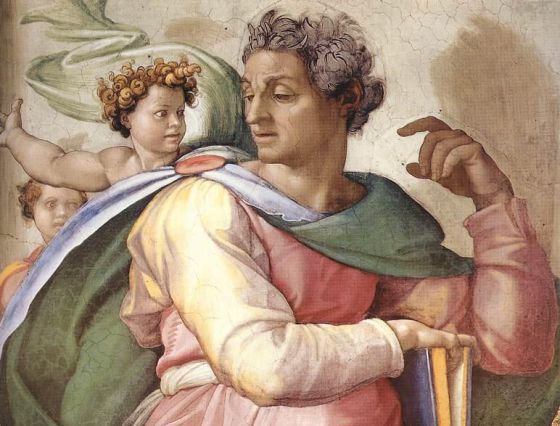
Fragmento de El profeta Isaías, de Miguel Ángel.
Los ecos de Platón fueron recogidos en versos por Miguel Angel Buonarroti (1475-1564). Amor, belleza, muerte, Dios y vida, y pecado, a la vez que la identificación de aquello que suministra alegría y felicidad. Estos son los temas preferidos por Miguel Angel Buonarroti en sus rimas, que aunque no adquieren lo sublime de sus pinturas y esculturas confirman su arte. Así se puede apreciar en la antología Rimas (1507-1555), seleccionadas por Manuel J. Santayana Ruiz, editado por Pre-Textos.
"La obra poética de Michelangelo se realizó ajena a la ambición característica del literato profesional, del erudito humanista; desigual y fragmentaria, va de la imitación de diversos estilos a la sencillez de un confiteor a las puertas de lo desconocido, pasando por la complejidad y el virtuosismo. Las Rimas describen una impresionante parábola temporal y nos dejan el apasionante autorretrato del que apenas hay esbozos, casi secretas alusiones, en su escultura y en su pintura", escribe Santayana Ruiz en el prólogo del libro.
Lirismo conmovedor, como su arte visual, Miguel Ángel siempre nos descubre belleza. Escuchemos al artista:
CVII
Mis ojos, que codician cosas bellas
como mi alma anhela su salud,
no ostentan más virtud
que al cielo aspire, que mirar aquellas.
De las altas estrellas
desciende un esplendor
que incita a ir tras ellas
y aqui se llama amor.
No encuentra el corazón nada mejor
que lo enamore, y arda y aconseje
que dos ojos que a dos astros semejen.
Me permito cerrar este Poemas en red de hoy con un comentario que ha hecho Elia sobre Miguel Ángel: "Nunca dejará de impresionarnos la sobrecogedora capacidad artística de Miguel Ángel Buonarroti. Su excepcional talento para la escultura, la pintura, el dibujo, la arquitectura y, en alguna medida, para la poesía es un enigma que lleva a preguntarnos sin cesar cuáles son las condiciones que hacen posible que surja lo que desde hace siglos se ha venido denominando "genio". Entendimiento, imaginación, perseverancia... aunque esta cuestión no se pueda clausurar, creo que todos aceptamos la conmoción que nos produce el legado que Miguel Ángel cedió a la posteridad.
* Rimas (1507-1555). Selección, versión, introducción y notas de Manuel J. Santayana Ruiz (Pre-Textos)
Lirismo conmovedor, como su arte visual, Miguel Ángel siempre nos descubre belleza. Escuchemos al artista:
CVII
Mis ojos, que codician cosas bellas
como mi alma anhela su salud,
no ostentan más virtud
que al cielo aspire, que mirar aquellas.
De las altas estrellas
desciende un esplendor
que incita a ir tras ellas
y aqui se llama amor.
No encuentra el corazón nada mejor
que lo enamore, y arda y aconseje
que dos ojos que a dos astros semejen.
Me permito cerrar este Poemas en red de hoy con un comentario que ha hecho Elia sobre Miguel Ángel: "Nunca dejará de impresionarnos la sobrecogedora capacidad artística de Miguel Ángel Buonarroti. Su excepcional talento para la escultura, la pintura, el dibujo, la arquitectura y, en alguna medida, para la poesía es un enigma que lleva a preguntarnos sin cesar cuáles son las condiciones que hacen posible que surja lo que desde hace siglos se ha venido denominando "genio". Entendimiento, imaginación, perseverancia... aunque esta cuestión no se pueda clausurar, creo que todos aceptamos la conmoción que nos produce el legado que Miguel Ángel cedió a la posteridad.
* Rimas (1507-1555). Selección, versión, introducción y notas de Manuel J. Santayana Ruiz (Pre-Textos)
Boy who touched Obama’s hair
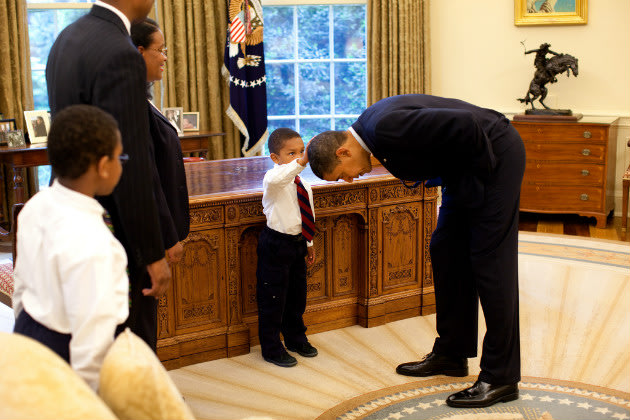 (Pete Souza/White House)Click image to see more photos.
The story behind a photograph showing a 5-year-old black boy touching President Obama's hair may be coming to your inbox soon.
The New York Times published the adorable back story about the photo—which has been hanging in the West Wing of the White House for more than three years—on Thursday, and it's quickly become the most-emailed article on the Times' website.
[Related: Obama can't stop talking about his girls]
In May 2009, the child, Jacob Philadelphia, was visiting the White House with his father, a former Marine who was leaving his 2-year stint working for the National Security Council as part of the White House staff. The father asked to take a family photo with the president. Jacob said he had a question for Obama, who was then in his fifth month in office.
The Times recounts the rest:
"I want to know if my hair is just like yours," he told Mr. Obama, so quietly that the president asked him to speak again.
Jacob did, and Mr. Obama replied, "Why don't you touch it and see for yourself?" He lowered his head, level with Jacob, who hesitated.
"Touch it, dude!" Mr. Obama said.
As Jacob patted the presidential crown, ... [White House photographer Pete] Souza snapped.
"So, what do you think?" Mr. Obama asked.
"Yes, it does feel the same," Jacob said.
As the paper noted, President Obama has largely avoided discussing race during his first term. But the photo "is tangible evidence" that the president "remains a potent symbol for blacks, with a deep reservoir of support."
"As a photographer, you know when you have a unique moment," Souza told the paper. "But I didn't realize the extent to which this one would take on a life of its own. That one became an instant favorite of the staff. I think people are struck by the fact that the president of the United States was willing to bend down and let a little boy feel his head."
http://news.yahoo.com/blogs/cutline/story-behind-white-house-photo-boy-touched-president-140641932.html
Assinar:
Postagens (Atom)